
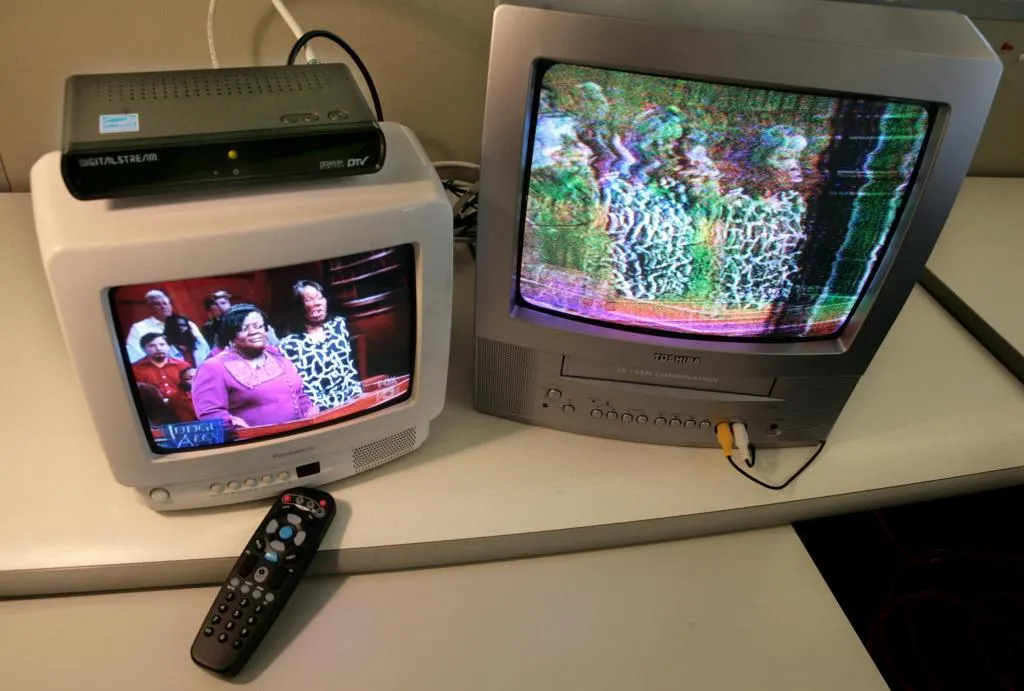
For most of television history, broadcast signals were analog—smooth, continuous electrical waves carrying picture and sound through the air. Then, in one of the biggest technological transitions of the 21st century, nations worldwide began shutting down analog broadcasts and switching entirely to digital. This shift changed not just how we watch TV, but how media is stored, transmitted, and produced.
Below is the story of how that transition happened, why digital came to dominate, and what advantages and limitations came with representing video in a digital form.
The Analog Era: Waves, Noise, and the Birth of Television
Early television in the 1930s–1950s was built entirely on analog technology. The idea was simple: convert moving images and audio into continuous electrical signals that closely imitate the original light and sound.
How Analog TV Worked
-
A camera captured light and transformed it into a varying electrical signal.
-
That signal modulated a radio wave (AM for video, FM for audio).
-
TVs decoded that wave and displayed it line-by-line using electron beams (CRT technology).
Strengths of Analog TV
-
Direct representation: The analog signal was continuous, making the system simple and intuitive.
-
Graceful degradation: If the signal got weak, the picture didn’t stop—it just got snowy.
Limitations of Analog
-
Noise accumulation: Any interference (weather, distance, electromagnetic noise) directly distorted the picture.
-
Bandwidth inefficiency: Analog channels needed wide broadcast frequencies.
-
No error correction: What was sent wasn’t always what was received.
-
Limited resolution options: Standards like NTSC, PAL, and SECAM were locked to fairly low resolutions.
By the 1980s and 1990s, it became clear that analog signals couldn’t keep up with growing demand for higher quality and more channels.
The Digital Revolution: Pixels, Packets, and Perfect Pictures
Digital television changes everything by representing images and sound using numbers, not continuous waves.
Instead of transmitting a smooth waveform:
-
The video is broken into pixels and frames.
-
The image becomes numerical data.
-
Compression algorithms shrink it down.
-
The TV reassembles the data into a picture.
Why the World Pivoted to Digital
Most countries began digital switchover between 2006–2013 (the U.S. finished in 2009). Digital TV wasn’t just a modernization—it allowed entire broadcasting systems to leap forward.
Advantages of Digital TV
1. Higher Quality
-
Digital signals carry HD, Full HD, and 4K content.
-
No static or snow—just a clear picture until the signal fully drops.
2. More Efficient Use of Spectrum
-
Multiple digital channels (“subchannels”) can fit into the space of one analog channel.
-
Freed-up frequencies (the “Digital Dividend”) were reused for cellular and emergency services.
3. Better Error Correction
-
Digital signals can detect and fix errors.
-
Interference is handled intelligently rather than visibly.
4. Easier Storage and Editing
-
Digital video integrates seamlessly with computers.
-
Enables DVRs, streaming, nonlinear editing, and file-based production.
5. Supports Modern Technologies
-
On-screen guides
-
Surround sound
-
Closed captioning
-
Interactive broadcasts
Digital wasn’t just about picture quality—it changed workflows across the entire broadcasting chain.
Historical Context: Why Digital Representation Was a Breakthrough
Digital representation in the 20th century was revolutionary because it solved inherent limitations of analog:
| Problem (Analog) | Digital Solution |
|---|---|
| Noise accumulates over distance | Error correction eliminates degradation |
| Hard to store (tapes wear out) | Files don’t degrade |
| Limited resolution | Scales up to HD and beyond |
| One channel per frequency | Multiplexing allows several |
When digital technology matured, broadcasters suddenly gained storage, distribution, and editing tools that were previously impossible. Entire film archives could be digitized, preserved, and streamed.
Modern Context: Digital Dominance in the Streaming Age
Today, “digital vs. analog TV” has shifted from broadcast signals to broader digital ecosystems:
Modern Advantages of Digital Representation
-
Streaming platforms (Netflix, YouTube, Twitch) rely entirely on digital compression.
-
AI-driven enhancement like super-resolution or noise removal only works on digital data.
-
Global distribution is instantaneous—no tapes, no shipping.
Digital representation also enables:
-
Cloud DVRs
-
Adaptive streaming (your resolution changes based on bandwidth)
-
Interactive content
-
Cross-device compatibility
In 2025, virtually everything from production to delivery is digital.
Limitations of Digital
Even though digital has enormous benefits, it isn’t perfect.
1. The Cliff Effect
With analog, a weak signal produced a fuzzy picture.
With digital, a weak signal often produces no picture at all.
2. Compression Artifacts
Heavy compression can cause:
-
blockiness
-
smearing
-
pixelation
-
audio warbling
This is especially noticeable during fast-moving scenes in sports or action films.
3. Dependence on Processing Power
Digital TVs require:
-
processors
-
decoders
-
memory
Older hardware can’t always handle new formats.
4. Storage and Bandwidth Demands
High-resolution digital content requires:
-
large file sizes
-
strong internet connections
-
robust server infrastructure
5. Obsolescence
Digital standards evolve quickly—H.264 → H.265 → AV1 → whatever comes next.
Equipment becomes outdated faster than analog gear used to.
Final Thoughts
The move from analog to digital TV was more than a technical upgrade—it was a foundational shift in how society creates, stores, and shares information. Analog brought us the first moving images in our living rooms; digital opened the door to HD broadcasts, internet streaming, and a global media ecosystem.
Digital representation has clear advantages in quality, reliability, and flexibility, but also brings modern challenges like compression artifacts, bandwidth requirements, and rapid obsolescence.
Still, the transition reshaped media in a way that makes today’s TV, streaming, and online video world possible.
This article was written with the assistance of OpenAI’s GPT-5